
A high-quality dynamic balancing system for drone motors and propellers. Eliminate vibration, extend component life, and improve flight performance — all with guided software and a repeatable 3-spin workflow.
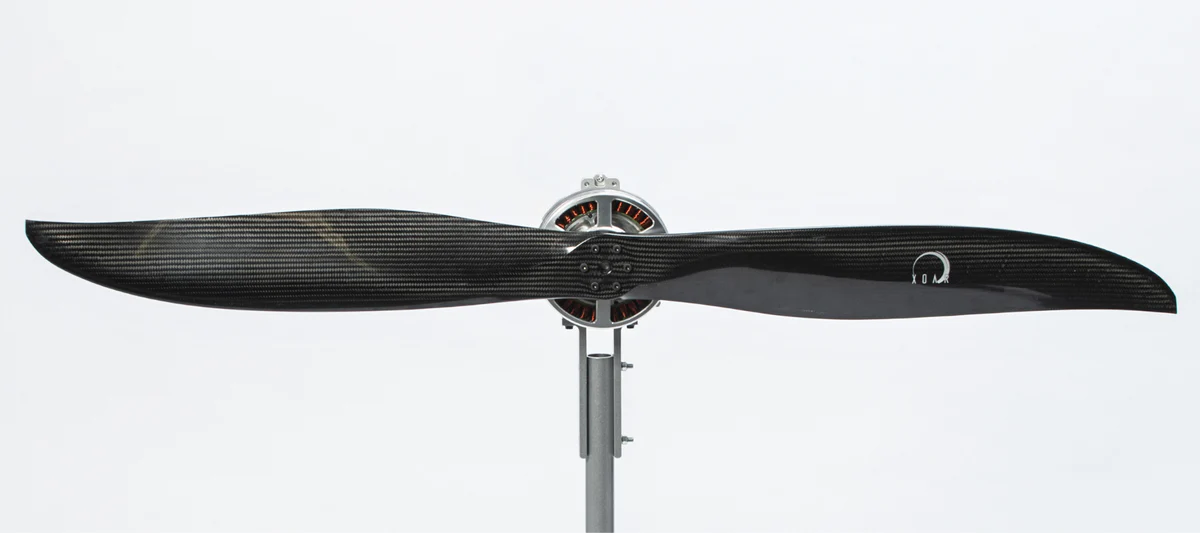
Even small imbalances generate significant vibration at speed — damaging components, shortening motor life, degrading sensor data, and reducing efficiency.
Vibration accelerates bearing wear, loosens fasteners, and causes premature motor failure. Dynamic balancing dramatically reduces these forces.
Vibration pollutes IMU, thrust, and torque measurements. Balanced propellers produce consistently cleaner test data and more repeatable results.
Reduced vibration means more stable hover, better control response, and improved efficiency — translating directly to longer flight times.
Meet ISO 21940-11 balancing standards for defensible quality records — essential for aerospace, defense, and regulated manufacturing programs.
Guided software and a proven 3-spin workflow means you don't need to be a vibration expert to achieve ISO-grade results.
Use the default quality grade of 6.3G or configure custom tolerances according to your specific ISO 21940-11 requirements and application.
Complete the full balance cycle — measurement, correction, verification — in just three guided spins. No complex setup or manual calculations required.
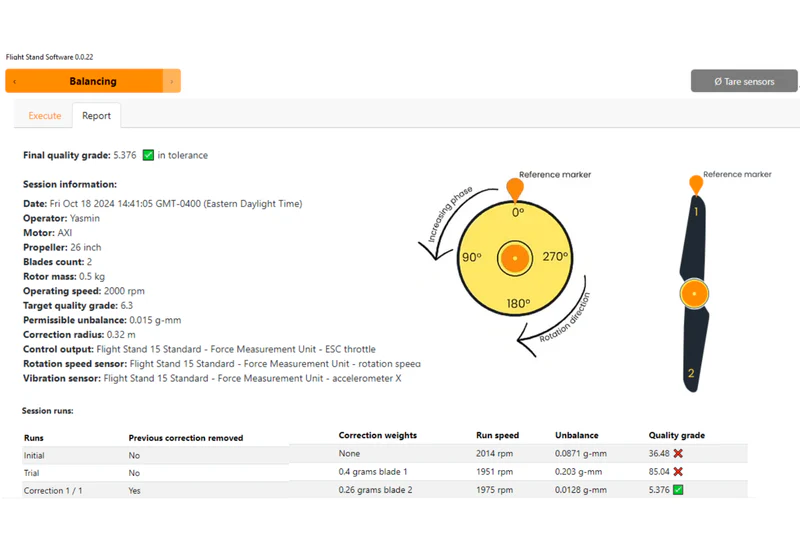
Step-by-step software interface walks you through each stage of the balancing process, giving precise correction recommendations at each step.
Detailed vibration measurement and spectral analysis at every step — see exactly how much imbalance is present and how much you've corrected.
The dynamic balancing module runs directly on your existing Flight Stand hardware — no separate balancing machine needed for most configurations.
Standardized workflow and calibrated measurements ensure consistent, reproducible results across different operators and test sessions.
The guided software walks you through each stage. No expertise in vibration analysis required.
Baseline imbalance capture
Mount the propeller on the Flight Stand and run the first spin. The software captures vibration data across the full RPM range and calculates the magnitude and phase angle of the imbalance.
Guided material addition or removal
The software tells you exactly where and how much correction mass to add (or remove). Apply the correction, then run the second spin to measure the improved residual imbalance.
ISO grade confirmation
The final spin confirms the propeller meets your configured ISO 21940-11 balancing quality grade. Software reports pass/fail status and logs the result for your quality records.
ISO 21940-11 defines the permissible residual imbalance for rotating machinery. The HOL-TRIN balancing system allows you to set the quality grade appropriate for your application — from consumer drones (G6.3) to precision aerospace components (G1.0 and below).
The dynamic balancing module is built into the Flight Stand software. Activate your balancing license and unlock the complete guided workflow.
Balancing license required. Contact our sales team to activate your dynamic balancing software license and unlock the full guided workflow on your existing Flight Stand hardware.
Any rotating propulsion system that operates at speed benefits from dynamic balancing — in R&D, manufacturing, and the field.
Balance propellers for UAVs and multirotors of all sizes — from small racing quads to large eVTOL-class vehicles.
Meet stringent aerospace balancing standards for fixed-wing propellers, turbofan blades, and other flight-critical rotating components.
Ensure test data quality by eliminating vibration-induced noise before taking thrust, torque, or efficiency measurements.
Integrate dynamic balancing into production workflows as a quality gate — verify every propeller before it ships or is installed on an aircraft.
The dynamic balancing module is an add-on to the Flight Stand software — activate the license and balance on the hardware you already have.
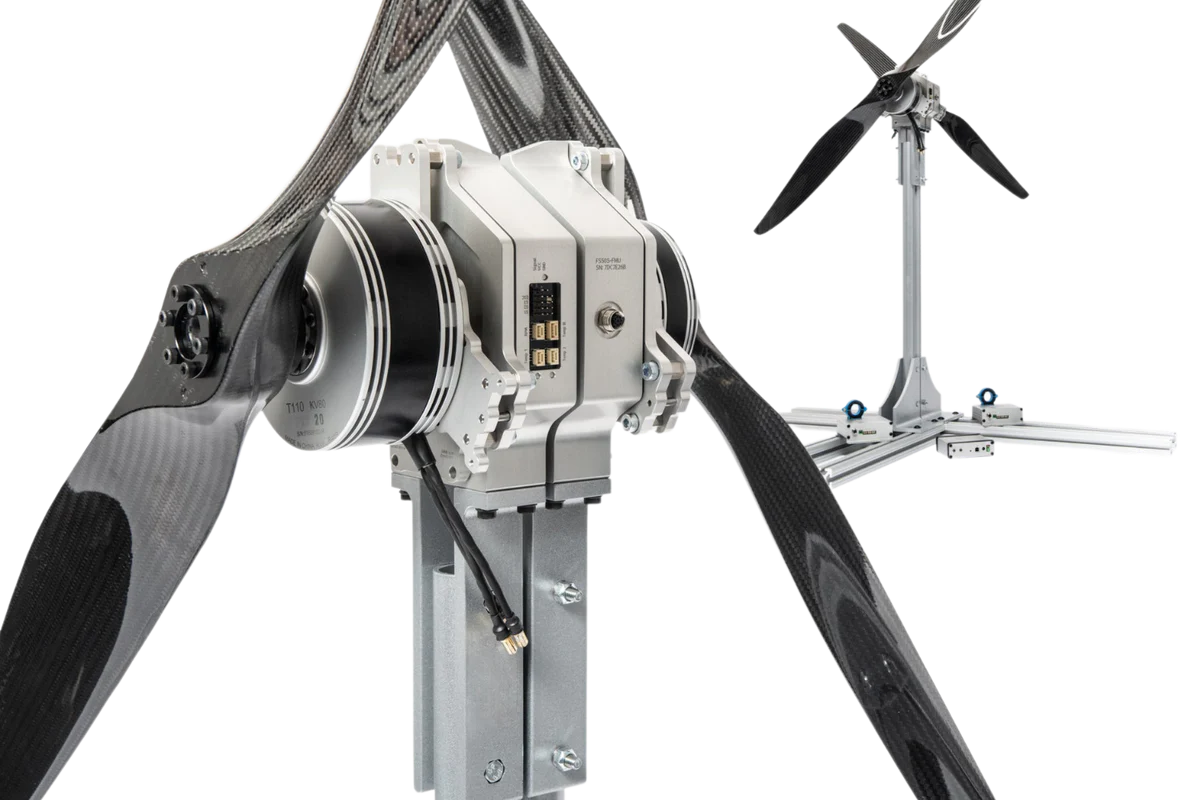
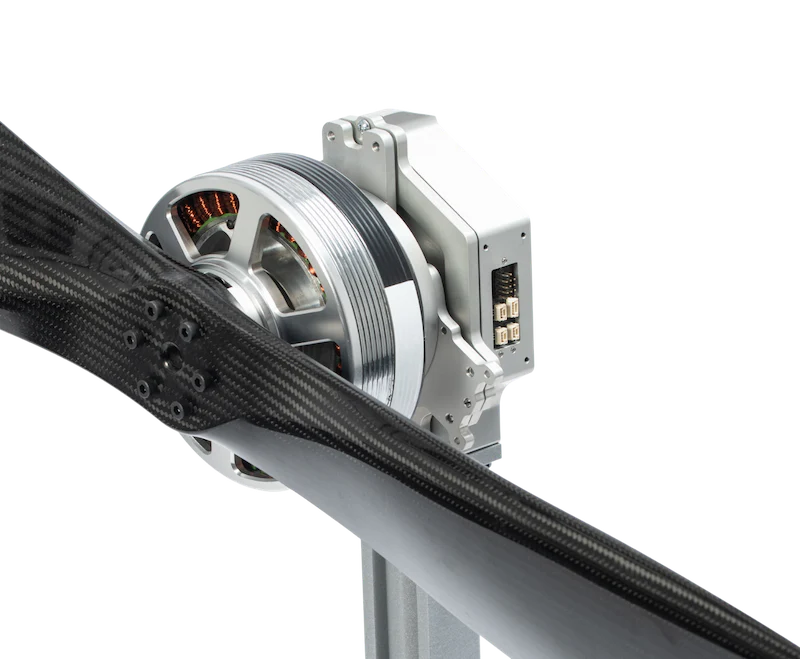
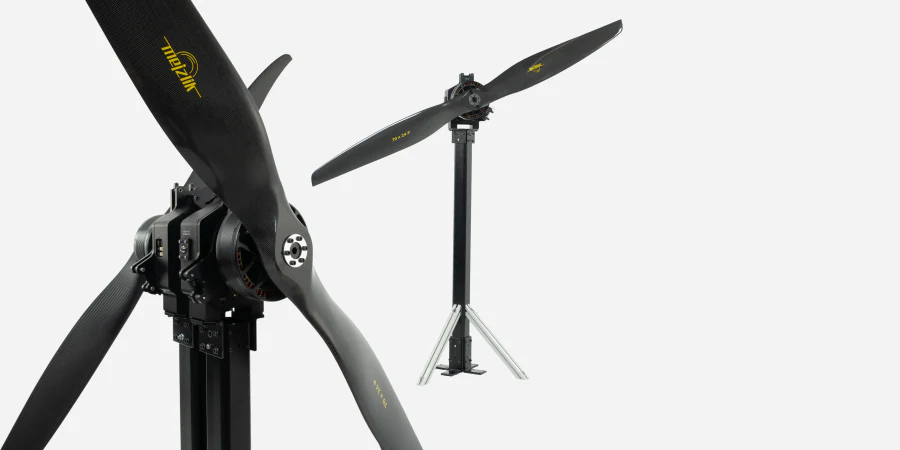
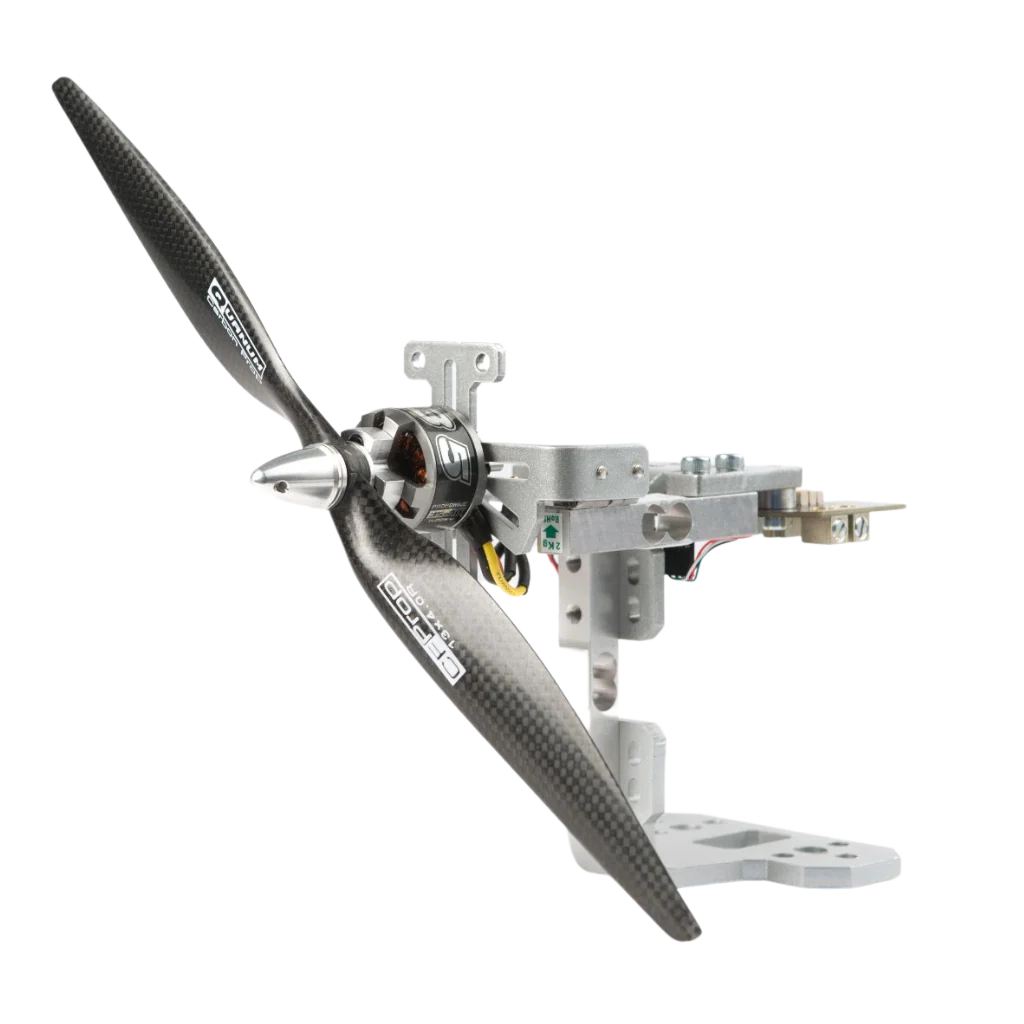
See how teams use the HOL-TRIN balancing system to improve their propulsion testing and flight performance.
"The 1780 has been a great piece of equipment. We discovered your low cost sUAS propeller test stand at AUVSI and I think you guys have done an outstanding job bringing this tool to the community. Keep up the great work!"
"Having a reliable ready-to-use-out-of-the-box thrust stand solution, like the Series 1585, was critical to meeting our need to test often and quickly iterate on designs — including using the balancing functionality to ensure our measurements were clean."
No. The dynamic balancing module runs directly on your existing Flight Stand hardware — the stand's load cell and vibration sensors are used to capture the imbalance data. You activate the balancing license in software and run the guided 3-spin workflow on the same hardware you already use for thrust testing.
The software supports the full range of ISO 21940-11 quality grades from G1.0 (precision) through G6.3 (standard) and beyond. The default is G6.3, which is appropriate for most UAV propeller applications. You can configure a stricter grade for aerospace or defense programs requiring tighter tolerances.
The balancing system supports propellers up to 26 inches in diameter on compatible Flight Stand hardware. For larger propellers or custom configurations, please contact our sales team to discuss your specific requirements.
Contact our sales team at sales@hol-trin.com or through the Contact Sales page. Our team will help you activate the balancing software license for your existing Flight Stand hardware and provide any setup guidance needed.
Dynamic balancing is more comprehensive than static balancing. Static balancing only corrects imbalance in a single plane, while dynamic balancing corrects imbalance across multiple planes — which is what matters for rotating propellers experiencing real operating forces. For professional applications, dynamic balancing is the recommended approach.
Contact our team to activate your balancing license or get a custom quote for the full system.